
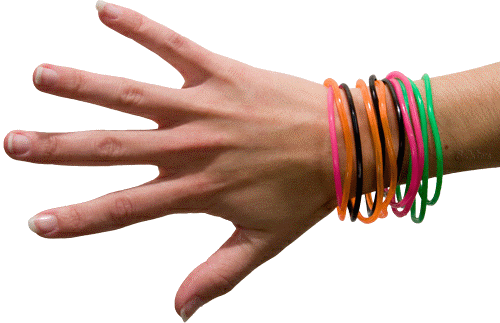
Claim: Youngsters signal sexual availability with jelly bracelets.
Example: [Collected via e-mail, November 2003]
Sex Bracelets are back - and kids are using them with out their parents knowing what they are doing.
Jelly bracelet fashion accessories have been around since the 80's. But instead of a fashion statement, they may be making a statement about your kid's sex life.
These bendable pieces of colored rubber have become a sexual code to many teens.
Here's a common breakdown:
Yellow: hugging
Purple: kissing
Red: lap dance
Blue: oral sex
Black: intercourse
In a game called snap, if a boy breaks a jelly bracelet off a girl's wrist, he gets a sexual coupon for that act.
It's become such a problem in some middle schools in Florida that districts started banning the bracelets.
If your daughter is wearing one of these bracelets, it may be cause for concern.
Origins: When is a fashion accessory popular among children more than a harmless fad?
That is the question that has been posited across the U.S. from time to time as rumors about "sex bracelets" spread from news market to news market. According to the whispers, the colorful jelly bracelets so beloved of grade- and middle-schoolers convey sexual intent and are used to arrange liaisons of an adult nature.
Jelly bracelets are thin rubbery bands which can be worn — singly or interconnected — on the wrists, ankles, or around the neck. They are available in an array of colors, and about $3 buys a pack of fifteen, making them
one of the more reasonably-priced fad items to come along lately. The bands initially acquired sartorial cachet in the 1980s when Madonna was seen sporting them, but fashion has its ebbs and flows, so that level of popularity was not maintained and the bracelets lost their appeal for a time. In the late 1990s the bracelets came back into vogue, and they have gained additional status in the 2000s as everything 80s has become cool again and new pop stars like Avril Lavigne and Pink are seen wearing these baubles.
Recent years have seen several occurrences of administrators in elementary and middle schools banning or warning against the wearing of jelly bracelets by students:
- In October 2003 the Alachua Elementary school in Florida banned children from wearing the stylish accents in response to rumors of the bijous conveying sexual meanings. Kids in that school were referring to them as "sex bracelets," and even pupils as young as those at the
Grade 3 level were making inappropriate sexual references about them. - The bracelets were banished from Malabar Middle School in Mansfield, Ohio. Students at that institution said they used the gimcracks only for innocent fun, but their principal chose to inveigh against this popular form of jewelry. "I'm trying to promote good character here at school so I simply am asking the students not to wear the jelly bracelets and not wear them to school anymore," said Joann Hipsher, the principal of the school. The colorful baubles were likewise made verboten in Fort McCoy, a kindergarten to
Grade 8 school in Marion County, Florida. - In September 2009, the prinicpal of Angevine Middle School in Lafayette, Colorado, sent an
e-mail warning to parents about jelly bracelets because "school staff members had picked up on conversations students were having about the bracelets" and the subject was becoming a classroom distraction, even though there had been no reports of students' actually engaging in the "snap" game.
Officials at each of these schools have taken this stance not because the acts signified by various colors are being carried out, but to protect children from premature sexualization. Nothing in the various "sex bracelet" news stories we've pawed through indicates girls are actually using these fashion items to declare willingness to engage in various acts, or that boys are breaking girls' bracelets in the belief that so doing grants them a right to claim what they think has been advertised. Rather, the bannings are an attempt to unring a bell — to return children to a time when they weren't so focused on sex.
Premature sexualization of young people is a valid concern, which is why parents are up in arms over the messages the bracelets purportedly communicate. Even if there's no actual hanky-panky going on (and as we've said, we see no reason to suppose that there is), such rumors encourage youngsters to view themselves and their classmates in sexual terms. It's disquieting to imagine children in
The current media hoopla makes it appear this theme of young people imbuing innocuous objects with secret sex codes is a new thing, yet it's actually been around for decades. Though the present incarnation focuses on cheap colorful bracelets, sexual themes that existed thirty years ago employed pull tabs from soft drink cans and labels from beer bottles. In those days, youngsters at various schools throughout the US and Canada heard pull tabs were "sex coupons" — all a fellow needed to do to convince the girl of his dreams to bed down with him was present her with a tab from a can of soda, and she had to say yes. (Why any gal would be compelled to swive with a random boy for a pull tab was not a question that seemed to occur to the fellows, but then what has logic ever had to do with teen and
At other schools a pull tab was said to be exchangable for a kiss, and in some versions of the rumor the condition of the item being presented dictated its worth: if the little ring was broken from its tab it was good for a kiss, but if the ring was unbroken it was redeemable for sex. The belief was simple in some circles
I remember that you would get more action if you got more of the top [of the can] off. If you managed to get the tab off w/o breaking the ring, that was worth a kiss. If you could tear it off such that the lid that folds down when you open the can comes with it, you got a blow job or a lay, or something. If you managed to tear the entire top off (very difficult, but not impossible. I've seen it done) you get "a lot of sex."
Somewhere in the mid-teens the rumor would shift to (or come to include) tabs from beer cans, presumably because suds were deemed a more adult beverage than fizz. The labels from beer bottles were also considered "sex coupons," redeemable with the gal of one's wet dreams. Provided the labels were intact, guys could claim their rewards from any girl they liked.
Another bit of beer label lore also
centered on the notion of a desirable outcome as repayment for, or recognition of, the skill it took to remove the label without tearing it. Some teen boys saw it as a sexual good luck charm, believing an untorn label indicated its remover would get laid soon. Conversely, teen girls viewed such accomplishment as a proof of their purity, intact labels proclaiming virginity.
Though at first blush the "sex bracelets" rumor appears to be a 2003 phenomenon, it actually dates to the
The pull tab and beer label "sex coupons" as well as the "shag bracelets" weren't real; they were wishful thinking codified into belief. Though the 70s were a hedonistic free-wheeling time, there were limits; girls weren't sharing their charms because they had been handed pull tabs or beer labels. As for the kids of the 90s, they weren't falling in with this over bracelets any more than their adolescent counterparts of twenty years earlier had over "sex coupons." Then, as now, young people wrestled with the heartbreak of adolescent desire, the devastation of liking someone and not being liked back or, even worse, not being noticed. How much simpler and less painful things would be if the one hungered for had to honor a coupon for a specific romantic reward when presented with it.
Yet it is not solely romantic yearnings and social awkwardness that give wings to such rumors — burgeoning sexual desire also plays its part. Boys caught up in the throes of hormonal tumult fervently pray for easy access to sex, so such a rumor falls upon their ears like rain on a parched field. Likewise, girls at that same stage are trying to come to terms with their impulses. One of the ways they do so is by abdicating responsibility for their urges to someone or something else, leaving them to preserve a particular view of themselves. The concept of being required to have sex would hold certain appeal because such obligation would take the decision out of their hands. The notion that a "sex coupon" could compel them to act out their desires gives them a way to vicariously explore lust while at the same time remaining a "good girl" in that there is no admission (internal or otherwise) of sexual hankerings.
The parents of thirty years ago were not going batty over "sex coupons" the way today's parents are over "sex bracelets" because they hadn't heard about them. Ignorance of their children's wacky belief cushioned them in a way that is no longer possible in our current media-saturated world. While it is true kids of the new millennium have a harder time holding on to their innocence, so too do their parents.
Since we published our original article in 2003, we've heard from hundreds of readers on this topic. The adults who write almost always say their kids are never going to wear those bracelets again; on the other hand, almost without exception, the middle- and high-school kids from all across the U.S. express shock that adults would think they were actually obeying this "code" and disappointment that their elders fail to understand the bracelets are no more than a cool fashion accessory that has attracted a silly rumor. Yes, many kids had heard the rumor before the media threw it at them (and many hadn't), but even those exposed to this snippet of lore in the wild (i.e., those who heard it from their friends as an item of schoolyard lore rather than gleaned it from the headlines of the day) received it as nothing more than a giddy "everybody knows" fact, right up there with "Bubble Yum contains
The greatest concern over "sex bracelets" appears not to be that anyone is going to engage in any real redeeming, but that children far too young to be entertaining such thoughts are being exposed to them. One way the pull tab and beer label beliefs differ from the "sex bracelets" code is the age of the participants; the rumor of thirty years ago was circulated mainly in high schools, but today's version is moving through grade and middle schools.
Barbara "youth marketed" Mikkelson
Last updated: 31 March 2014
 | Sources: |
Aguilar, Alexa and Kaitlin Bell. "Rumors Link Bracelets to Sex Game." St. Louis Post-Dispatch. 18 November 2003. Frosch, Dan. "School Bans Bracelet Used in Sex Game." The New York Times. 12 September 2009. Heckel, Aimee. "Jelly Bracelets May Be Coupons for Sex." The [Boulder] Daily Camera. 30 November 2003. James, Douane. "Principal Puts Ban on 'Sex Bracelets.'" Gainesville Sun. 18 October 2003. Whitmire, Lou. "Dr. Phil Takes on 'Risque' Bracelets.'" Mansfield News Journal. 11 November 2003. NBC5i.com [Dallas]. "Bracelets With Rumored Sexual Meaning Worry Parents." 18 November 2003. Ocala Star-Banner. "Latest Fashion Fad Raising Marion Parents' Concern." 13 October 2003. NBC Channel 10 [Philadelphia]. "'Sex Bracelets' Cause for Parental Concern." 7 November 2003. Time. "Parents: Brace Yourselves." 27 October 2003. NBC 4-TV [Washington]. "Jelly Bracelets Linked to Sex Game." 13 November 2003. WEWS-TV [Cleveland]. "Principal Bans Jelly Bracelets for Sexual Innuendo." 4 November 2003.