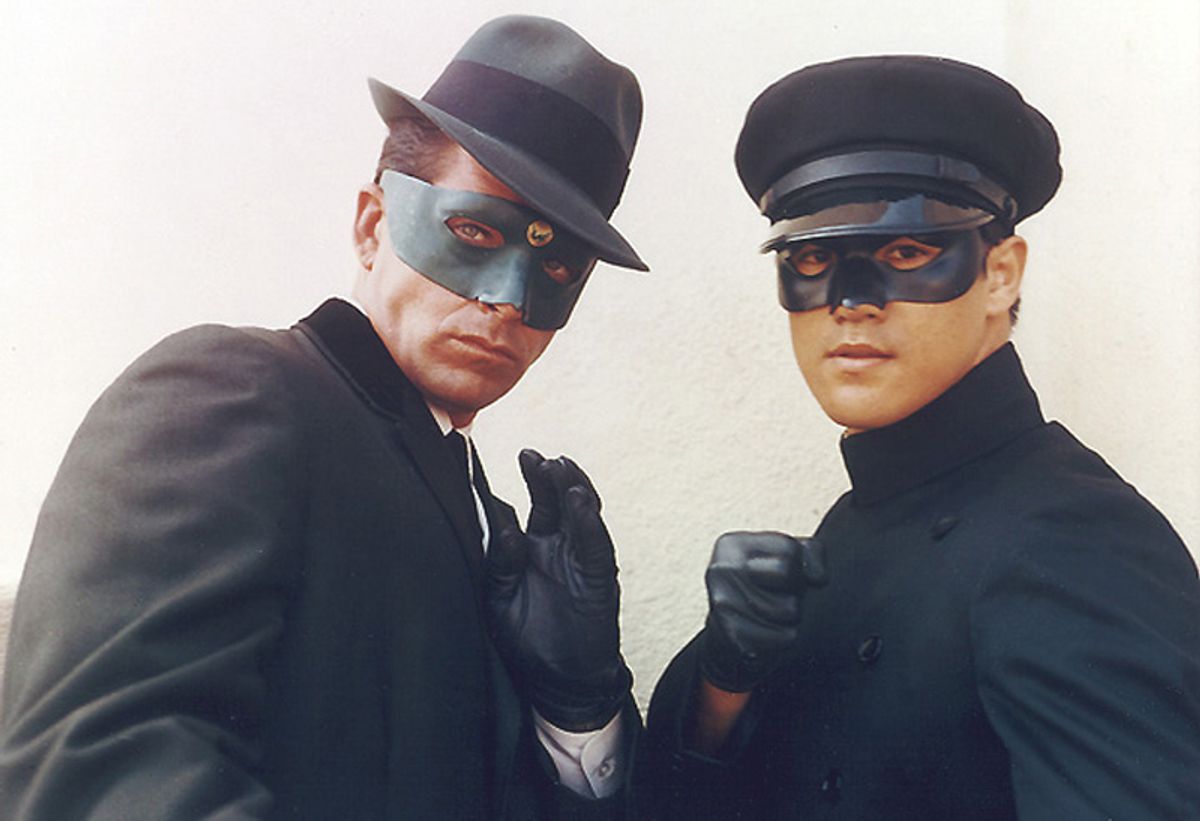

That the Green Hornet, who battled crime on the radio airwaves from 1936 to 1952, bore many resemblances to a modern day Lone Ranger was no coincidence. Both programs were created under the aegis of George W. Trendle at WXYZ in Detroit; thus both had similar three-word titles consisting of "The" followed by a monosyllabic adjective and a two-syllable noun, and both featured main characters who fought crime while remaining outside the realm of official law enforcement (and were often mistaken for outlaws themselves), had faithful sidekicks (both of whom were men of different ethnicities with two-syllable names ending in 'o'), employed masks in their crime-fighting guises to create secret identities, and always refrained from killing or maiming the foes with whom they tangled.
And although the metropolitan Green Hornet could hardly be expected to pursue lawbreakers mounted on horseback as his western precursor did (on his faithful steed Silver), the similarity between the two heroes was reinforced by the Green Hornet's automotive conveyance possessing a name ("Black Beauty") that was both equine and formed from a color word. The link between these two unconventional lawmen was made more explicit by a background history that made the Lone Ranger the great-uncle of Britt Reid, the "daring young publisher" who matched "wits with the underworld, risking his life that criminals and racketeers" might feel "the sting of the Green Hornet!"
Unlike the previous century's Lone Ranger, however, the Green Hornet had a crime-fighting companion whose heritage became potentially troublesome in light of current events. Kato, Britt Reid's valet, was an Asian of Japanese descent, a distinction of some consequence when events in the Pacific in the late 1930s and early 1940s, capped by a surprise Japanese attack on the American naval base at Pearl Harbor on 7 December 1941, inexorably drew Japan and the United States into war with each other. Against this background (and the resultant anti-Japanese backlash in America) arose the legend that the character of Kato was originally identified as being Japanese, but after Pearl Harbor his nationality was abruptly changed.
Several different explanations have been offered about exactly what took place regarding Kato's nationality after the beginning of World War II, including claims that:
- Kato had always been described as Japanese, but immediately after the attack on Pearl Harbor he was suddenly referred to as Filipino instead.
- Kato had previously been referred to only as an "oriental" (i.e., an Asian of unspecified nationality), but after Pearl Harbor he was specifically identified as Filipino.
- Kato had been explicitly described as Filipino all along, and no change in his nationality took place at all after the outbreak of war in the Pacific.
The real answer is a somewhat confusing mixture of elements from all of these explanations.
Although print ads run before the premiere airing of the Green Hornet on radio described Kato as "the Jap butler," the first two broadcasts simply referred to him as an "oriental"; not until the third episode was he characterized as Japanese (a nationality which matched that of the actor who portrayed him, Tokutaro Hayashi). Kato's nationality became problematic after Japanese military incursions into China escalated into war between those two countries in mid-1937 (with American political sentiment decidedly on the side of the Chinese), so beginning in January 1938 (nearly four full years before the attack on Pearl Harbor) Kato reverted to being an "oriental" who served as Britt Reid's "faithful valet" (rather than his "Japanese valet"). As noted in Grams and Salomonson's history of the The Green Hornet, as early as 18 July 1939, more than two years before the Pearl Harbor attack and American entry into World War II, a Green Hornet radio script referred to Kato as Reid's "Filipino valet" (although the word "Filipino" was later scratched out and replaced with "faithful"), as writer Fran Striker wrestled with how to introduce an unexplained change in Kato's nationality to the radio audience.
The change in nationality was eventually implemented, and starting with the broadcast of 21 June 1941, Kato was specifically referred to as Filipino. However, after July 1941 several months passed with no subsequent reference to Kato's Filipino nationality, and (due in part to the time lag between the completion of scripts and the production of episodes) the next mention of Kato's Filipino background didn't take place until the broadcast of 10 January 1942, a month after the Pearl Harbor attack. Since just a few sparse references to Kato as a Filipino had been made several months prior to Pearl Harbor, and those references resumed shortly after Pearl Harbor, many listeners naturally remembered the attack on Pearl Harbor as the dividing line between Kato's shifting Japanese/Filipino background.
So, to sum up:
- Kato was indeed portrayed as being of Japanese descent during the first two years of the Green Hornet radio program.
- Two years later (long before the attack on Pearl Harbor), due to Japan's political situation, reference to Kato's Japanese background was eliminated, and he became an Asian of unspecified nationality.
- Several months before U.S. entry into World War II, Kato was initially described as being of Filipino background.
Kato's national origins became even more confused by productions of The Green Hornet in other media. The 1940 Universal Pictures Green Hornet film serial portrayed Kato as Korean, and press material for the short-lived mid-1960s Green Hornet television series indirectly referred to Kato (played by martial arts star Bruce Lee) as Chinese.
A similar type of sudden character change took place forty years later, with the 1981 debut of the television series The Greatest American Hero, a superhero parody show featuring a caped, crime-fighting high school teacher named Ralph Hinkley. Just a few weeks later, President Ronald Reagan was the target of an assassination attempt by a man named John Hinckley, and the show's main character was thereafter referred to simply as "Mr. H" (and occasionally "Mr. Hanley"), although his original name of "Hinkley" was eventually restored later in the series' run.