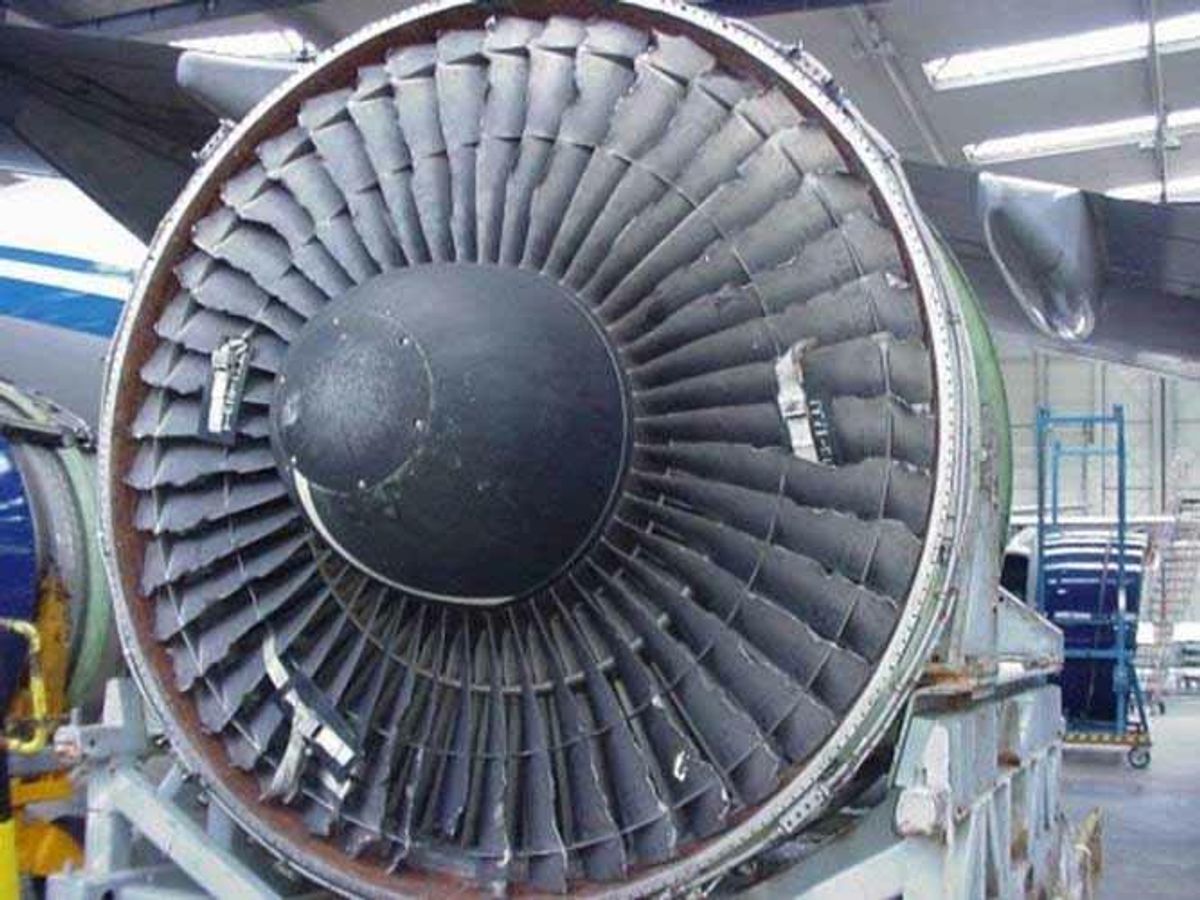

Claim: Photographs show a damaged jet engine repaired with seatbelts during a refueling stop.
Example:[Collected via e-mail, 2006]
UNSCHEDULED STOP
UNSCHEDULED REFUELING: Choose your airlines carefully. Incredible! You might not want to fly "AIR CHINA"
Perhaps a Junk might be a safer mode of travel.
This is an excellent example of why any prudent traveler should generally stick with North American carriers, Western European carriers and a few other carriers like Quantas, Air New Zealand, and Singapore.
A pilot for a Chinese carrier requested permission and landed at FRA (Frankfurt, Germany) for an unscheduled refueling stop. The reason became soon apparent to the ground crew: The Number 3 engine had been shut down because of excessive vibration, and because it didn't look so good. It had apparently been no problem for the tough guys back in China: they took some sturdy straps and wrapped them around several of the fan blades and the structures behind, thus stopping any unwanted windmilling (engine spinning by itself due to airflow passing thru the blades during flight) and associated uncomfortable vibration caused by the suboptimal fan.
Note that the straps are seatbelts....how resourceful!
After making the "repairs", off they went into the wild blue yonder with another revenue-making flight on only three engines! With the increased fuel consumption, they got a bit low on fuel, and just set it down at the closest airport for a quick refill. That's when the problems started: The Germans, who are kind of picky about this stuff, inspected the malfunctioning engine and immediately grounded the aircraft.
(Besides the seatbelts, notice the appalling condition of the fan blades.)
The airline operator had to send money to get the first engine replaced (it took about 10 days). The repair contractor decided to do some impromptu inspection work on the other engines, none of which looked all that great either.
The result: a total of 3 engines were eventually changed on this plane before it was permitted to fly again.
LOOK AT THIS ENGINE.....The aircrew obviously had more balls than brains. Hard to believe anyone would take off with an engine in this condition.
Origins: The
photographs displayed above have been circulated in versions with text attributing them to Air China as well as a number of different airlines, in each case accompanied by the claim that a ground crew had hastily (and dangerously) repaired damaged jet engines on one of the airline's planes by using seat belts to hold them together. Although the photographs are real, they have nothing to do with Air China, and they do not document a case of substandard repairs or an occurrence anything like the circumstances described in the accompanying text.
On 22 November 2003, an Airbus A300 cargo plane operated by international express courier DHL scheduled to fly to Bahrain was struck on the left wing by a surface-to-air missile shortly after takeoff from Baghdad, Iraq. Despite the resulting severe wing damage, loss of hydraulic flight control, and fire, the three-man crew managed to return the aircraft to Baghdad International Airport and land it safely.
As the incident was described in the Aviation Safety Network (ASN) database:
The Airbus, owned by European Air Transport and operated on behalf of DHL, was hit by a SAM-7 surface-to-air missile while climbing through 8000 feet shortly after departure from Baghdad. The missile struck the wing and penetrated the no. 1A fuel tank. Fuel ignited, burning away a large portion of the wing. To make things worse, the plane lost all hydraulics and the pilots had to attempt a landing back at Baghdad Airport. After a missed approach they were forced to circle the field until they finally landed heavily on runway 33L16 minutes later. The Airbus veered off the left side of the runway, travelled about 600 metres through soft sand, struck a razor wire fence and came to rest on a downslope. The Airbus was repaired and offered for sale in 2005.
The pictures included in the e-mail show engine fan blades damaged by the intake of debris produced by the missile hit, with the "seatbelts" being tie-down straps used to secure the engine to a shipping stand as it is removed from the aircraft for inspection, repair, or replacement.
Last updated: 13 January 2009
The URL for this page is http://www.snopes.com/photos/airplane/airchina.asp