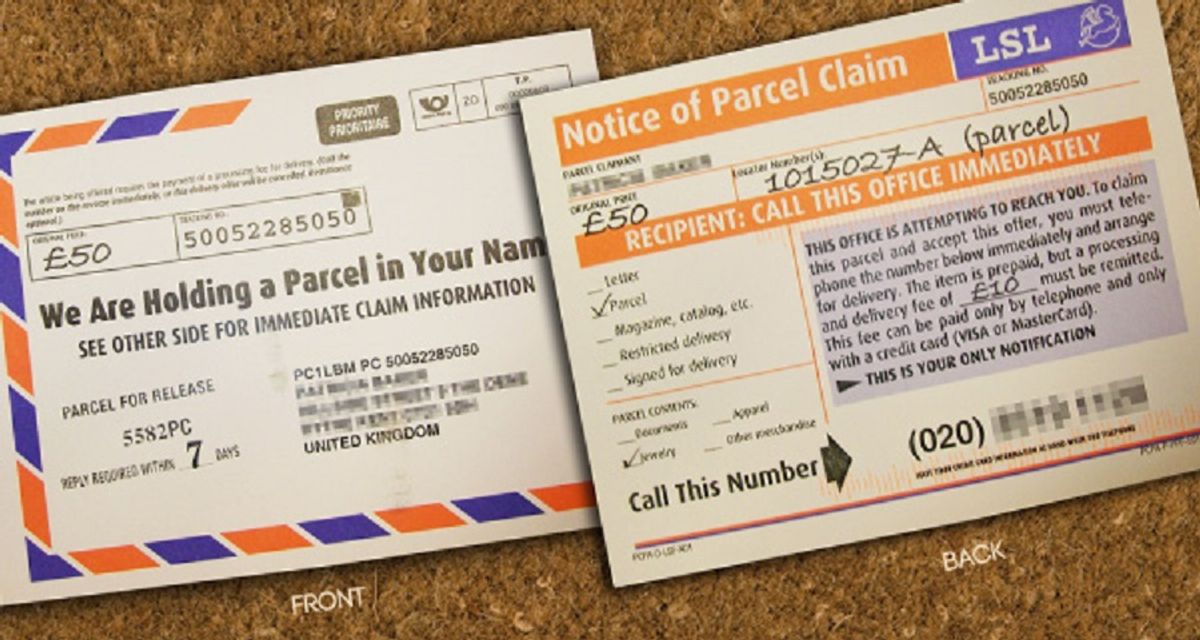

Although many scams involve the use of telephones to contact or extract information from potential victims, a few varieties of fraud target telephone service itself as a means of obtaining ill-gotten revenue from unsuspecting prey. One common variety of telephone service fraud involves obtaining information or employing trickery that allows the scammer to place long-distance calls and bill them to someone else (as in the
In December 2005, many UK residents were targets of the latter variety of scam, one that attempted to lure them into placing calls to a premium rate number and keep them on the line for several minutes. (Premium rate or
If you receive a card through your door from a company called PDS (Parcel Delivery Service) saying that they have a parcel awaiting delivery instructions and can you contact them on 0906 6611911 DO NOT call the number as this is a mail scam originating from Belize.
If you call the number and you start to hear a recorded message you will already have been billed £15 for the phone call.
If you do receive a card with these details, then please contact Royal Mail Fraud on 02072396655 or ICTIS at https://www.icstis.org.uk or your local trading standards office. This is a genuine scam.
Hi all just received this via a solicitors office so we know it's genuine.
BE AWARE PLEASE.Postal Scam:
Can you circulate this around especially as Xmas is fast approaching - it has been confirmed by Royal Mail. The Trading Standards Office are making people aware of the following scam:
A card is posted through your door from a company called PDS (Parcel Delivery Service) suggesting that they were unable to deliver a parcel and that you need to contact them on 0906 6611911 (a Premium rate number).
DO NOT call this number, as this is a mail scam originating from Belize.
If you call the number and you start to hear a recorded message you will already have been billed £315 for the phone call.
If you do receive a card with these details, then please contact Royal Mail Fraud on 020 7239 6655.
The bait for this scam was the distribution of official-looking postcards bearing the name "Parcel Delivery Services" (PDS) to residences, each card proclaiming that a package was awaiting delivery (usually one said to contain a digital camera) and that the recipient needed to call PDS to obtain a "security confirmation code" to effect delivery of the parcel. What many consumers failed to notice (or heed), however, was the small print on the card informing them that the phone number provided was a premium rate number with a whopping
When you ring up, the recorded voice promises you will shortly be give the 'security confirmation code' but first you're asked a series of rather personal 'market research' questions about your marital status and how often you drink alcohol. In fact, six tedious minutes pass before you're finally given the code for your camera. It's a classic
technique — and it's just cost you £9.00. Expensive call!
Not surprisingly, investigators failed to turn up any complainants who actually received digital cameras from PDS, and PhonePayPlus (formerly the Independent Committee for the Supervision of Standards of Telephone Information, aka ICSTIS), the group that oversees premium rate services in the UK, removed access to the service (which was using up to
Because the Internet-circulated warning did not just up and go away in December 2005 once the problem was sreolved, people continued to spread the alert in
A STATEMENT FROM PHONEPAYPLUS ABOUT THE CURRENT 'POSTAL SCAM' CHAIN EMAIL
PhonepayPlus, the phone-paid services regulator, is aware that a chain
PhonepayPlus appreciates that recipients of the email may want to find out more information about the alleged scam and has therefore issued the following statement:
- The chain email refers to a service (operating on 0906 6611911) that was shut down by PhonepayPlus (then ICSTIS) in December 2005.
- PhonepayPlus subsequently fined the company that was operating the service, Studio Telecom (based in Belize), £10,000.
- The service is NO LONGER running and has NOT been running since December 2005.
- You do NOT need to contact PhonepayPlus, or the Royal Mail, about this service as it was stopped almost four years ago.
- If you receive a copy of the email warning you about the alleged scam, please do NOT forward it to others. Instead, please forward this statement from PhonepayPlus.
- If you receive a delivery card through your letterbox which you do not believe is genuine and which asks you to dial a premium rate number, you can contact PhonepayPlus on 0800 500 212
(Mon-Fri, 8am-6pm) for further guidance.- Please go to https://www.phonepayplus.org.uk/output/FAQ.aspx for useful information about how to recognise phone-paid services and understand what they cost, and some simple tips to help you enjoy using services with confidence.
- For more detailed information about our work, please visit www.phonepayplus.org.uk.
Although the specific warning e-mail reproduced at the head of this page is out of date, it represents a common form of telephone fraud that has been used in the past and will likely be used again, so the public is well advised to be aware of it. UK telephone customers who find unexpected premium rate charges on their phone bills can obtain more information by looking up the associated phone numbers via the number checking facility on the PhonePayPlus web site, and they can file complaints about premium rate services through PhonePayPlus' online