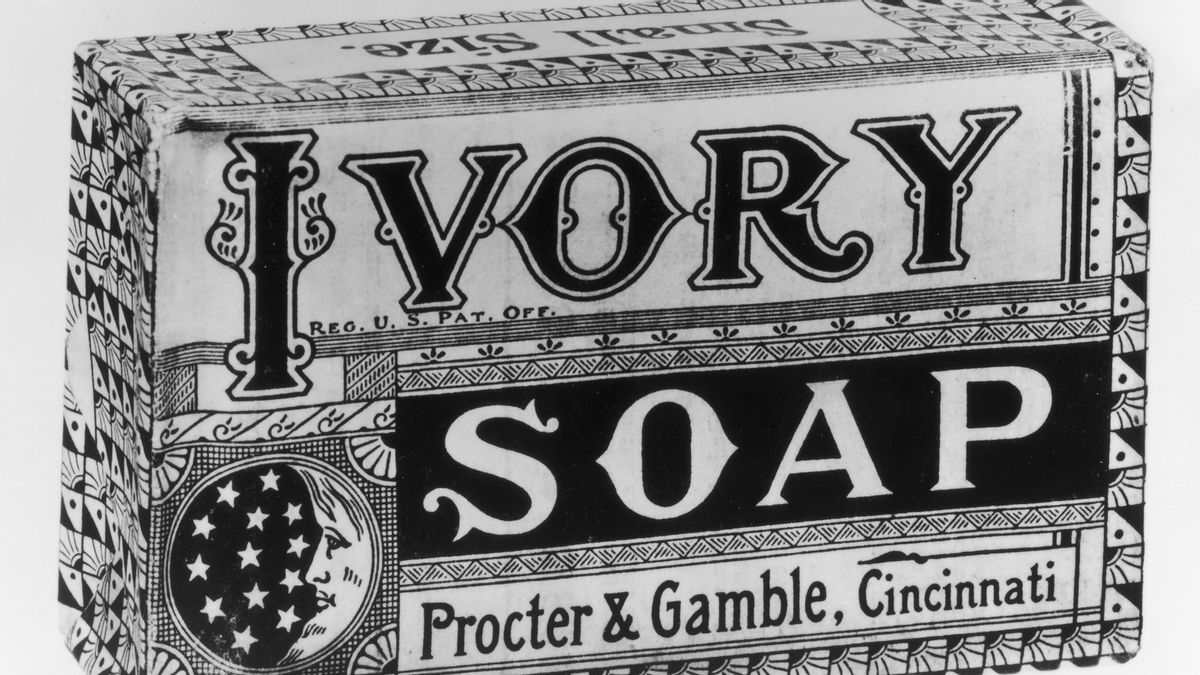

Origins: In 1878, managers at Procter & Gamble's soap and candle factory in Cincinnati, Ohio, were puzzled by consumer requests for more of "the soap that floats." The company had recently introduced a new product called White Soap, an offering meant to compete with the fine soaps from Spain that were then taking a fair bite out of the American market. Could White Soap be the mysterious "soap that floats" consumers kept inquiring about?
The story that Procter & Gamble had always offered was that the "floating soap" was the result of an accident:
Perhaps Ivory's most famous feature — its ability to float — was the result of an accident! An employee failed to shut off the soap-making machine when he went to lunch. When he returned, he found the soap mixture puffed-up and frothy. After consulting with his supervisor, the decision was made to finish and ship the soap since the ingredients had not been changed in any way by the longer mixing time.
About a month later, P&G received orders for more of "the floating soap." The people in the Order Department were perplexed. Only after some detective work was the mystery solved. The long forgotten lunch-time accident had produced a floating soap!
Perhaps Ivory's most famous feature — its ability to float — was the result of an accident! An employee failed to shut off the soap-making machine when he went to lunch. When he returned, he found the soap mixture puffed-up and frothy. After consulting with his supervisor, the decision was made to finish and ship the soap since the ingredients had not been changed in any way by the longer mixing time.
About a month later, P&G received orders for more of "the floating soap." The people in the Order Department were perplexed. Only after some detective work was the mystery solved. The long forgotten lunch-time accident had produced a floating soap!
Because of this employee's supposed error, far more than the usual amount of air was incorporated into that one particular batch. Rather than confess to his screw-up, he sent the overwhipped product down the line. The batch hardened, was chopped into bars, and was sent on to market with no one other than the one errant worker (and possibly his manager) knowing anything was out of place about it.
In 2004, however, a Procter & Gamble company archivist found information documenting that the "floating soap" came about through deliberation, not accident:
Company archivist Ed Rider said he has discovered that a P&G chemist, James N. Gamble, had previously studied with another chemist who already knew how to make soap float. Gamble was son of company co-founder James Gamble.
Rider said he has discovered a notebook entry from 1863 in which Gamble wrote: "I made floating soap today. I think we'll make all of our stock that way."
The company's early leadership realized that the floating capacity could have marketing appeal, Rider said.
Whatever its origins, consumers loved this exciting new product because they were no longer fishing about in murky water for elusive soap. The new White Soap refused to get lost, as it would pop up to the surface no matter how many times it was dropped into a bucket or sink. Procter & Gamble was quick to see the advantages of marketing such a product. Orders were given to henceforth produce all batches of White Soap as "floating soap" to meet consumer demand, and in October 1879 the first bar of Ivory Soap was produced:
Today, Ivory floats because we intentionally whip a small amount of air into Ivory as it's being made. This makes the soap lighter than water, so it floats. This process also makes each bar of Ivory velvety smooth and easy to lather.
The famous "99.44/100% Pure" slogan came about as the result of laboratory analysis:
This famous slogan originated in the 1800's when samples of Ivory were sent to college chemistry professors and independent laboratories for analysis. Comparison tests were made with castile soaps — the standard of excellence at that time. One chemist's analysis was in table form with the ingredients listed by percentage. Harley Procter totaled the ingredients which did not fall into the category of pure soap — they equaled 56/100%. He subtracted from 100, and wrote the slogan "99-44/100% Pure®: It Floats." This became a pledge of quality to Ivory consumers. This phrase is so identified with Ivory, it's registered as a trademark with the United States Trademark office.