

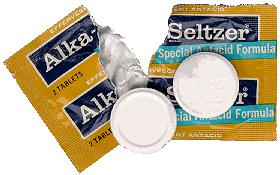
Claim: Alka-Seltzer dramatically increased its sales by instructing consumers to use two tablets instead of one.
Origins: The history of corporate America is replete with examples (both real and apocryphal) of schemes to manipulate consumers into not only purchasing new products, but into buying more of the products they already use. Nearly everyone has heard the tale of the clever marketing man who doubled his company's sales of its shampoo product by adding the final word to the instructions "Lather. Rinse. Repeat." Umpteen comedians have mused on the deliberate waste promoted by selling hot dogs in packs of eight, but buns in packages of twelve. And "artificial obsolescence" — the yearly introduction of superficial stylistic changes in big-ticket items such as automobiles and appliances in order to lure status-conscious consumers into replacing perfectly functional products — dates from the 1920s:
When Sloanism began back in the 20s, the notion that a serviceable product could be rendered obsolete by appearance alone was transferred from the apparel of the upper class to the single most important industrial product in America. With the help of the ad copywriter, status and symbolism became compelling reasons for buying a new car, even though the old, black Ford out in the yard still ran like a top.1
In the 1920s the auto industry had been faced with a crisis: by 1926, according to reliable estimates, everyone who could afford a car already had one, and in 1927 production and sales declined for the first time. The answer was not Fordism — the durable, dependable, unchanging
In
the early 1960s,
introduced in the early days of television and by the 1960s was one of the corniest mascots still in use to sell an adult product,
Traditionally, pain-relief products had been advertised in gruesome commercials filled with horrors that would have given you pain if you didn't already have it. People ran around groaning, clutching their heads and stomachs, men and women crawled into corners and shrieked "Pain! Pain! Pain!" at television viewers who immediately turned off their sets. In one Frankensteinian commercial an ugly Neanderthal man went through a series of tortures, hammers dropped from the skies to pound his head, hoses appeared like snakes to whip him with water, straitjackets tied him up, you wanted to scream at him to "get off my telly!" People did not watch proprietary drug advertising unless they already had a headache or stomach problem and were looking for a quick fix, so most of the time, from the advertiser's point of view, advertising was like throwing money into a black hole.2
The creative minds at the
It was followed by 16 completely different commercials, each entertaining and stylish, each giving you a different reason to take
[We] created the kickoff commercial that set the style for all the variety of commercials that followed. It was a truly wonderful, iconic commercial, an ovation to stomachs, a sweet-natured montage of big ones, little ones, slim ones, fat ones, all filmed at stomach level. There was a street digger's jackhammer stomach, a young chick's bare midriff, two men talking, facing each other, one with a flat stomach and one with a big round one, an array of stomachs presented with self-deprecating humor and sweet humanness to a happy, bouncy tune. "No matter what shape your stomach's in" was its opening phrase. Self-deprecating humor was new and popular in the sixties and unheard-of in drug commercials, when it appeared it was news.
One of these
But the directions on the package said to take only one. And all the old Speedy commercials demonstrated only one fizzing in water. [We] did a little dance with Dorothy Carter in the laboratory. What a stroke of good fortune that was! We changed the directions on the packages and began showing two
We met an attractive doctor at Miles [Laboratories], Dorothy Carter, who demonstrated to us that in order for aspirin to break through the pain barrier it often required two aspirins, not one, to do the job. As aspirin is one of the ingredients that make
their emphasis on two
A common bit of trivia claims that
Last updated: 27 October 2013
 | Sources: |
2. Lawrence, Mary Wells. A Big Life (in Advertising). New York: Alfred A. Knopf, 2002. ISBN 0-375-40912-2 (pp. 24-29). Mann, Charles C. The Aspirin Wars: Money, Medicine, and 100 Years of Rampant Competition. New York: Alfred A. Knopf, 1991. ISBN 0-394-57894-5. 1. Marling, Karal Ann. As Seen on TV: The Visual Culture of Everyday Life in the 1950s. Cambridge: Harvard University Press, 1994. ISBN 0-674-04882-2 (p. 136).