Claim: Forger steals money by manipulating ABA symbols on checks.
Origins: One of the ways paperhangers were supposedly able to pass bad checks easily once upon a time was by manipulating the American Bankers Association (ABA) numbers encoded on nearly all checks with magnetic ink. Although the American banking system relies heavily upon this information for the automated sorting and routing of checks, many bank personnel are unfamiliar with or pay little attention to these numbers.
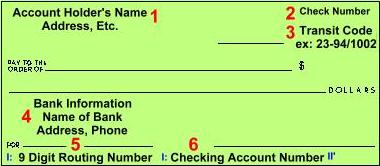
The system has changed a little bit over the years, but nowadays checks typically bear a nine-digit ABA routing number printed in the bottom left-hand corner (indicated as #5 in the above diagram). In general, the first four digits are a Federal Reserve routing symbol,
identifying which of the twelve Federal Reserve districts the check was printed in (and a city within that district). The next four digits are an ABA institution identifier which designates the bank on which the check is drawn, and the last number is a check digit.
Check forgers manipulated the banking system by altering the ABA routing numbers on the bad checks they passed so that the numbers identified different banks than the ones whose information was printed on the face of those checks. For example, a forger attempting to pass a bad check in Boston might present a check whose printed information indicated it was drawn on a Philadelphia bank, but whose
routing number had been altered to indicate that it came from a bank in the 12th Federal Reserve district (which encompasses the western United States). The Boston bank would expect a check drawn on a Philadelphia bank to clear within two or three days and assume that if it hadn't been kicked back to them by the end of the third day, it was good. However, the altered routing number would cause the automated sorting machinery to send the check on to a San Francisco clearing house for processing. Once the check arrived in San Francisco, a computer there would kick it out because the routing number didn't match the other information encoded on the check, and the check would be mailed back to the Philadelphia bank for processing. This whole process could take several days, but because the Boston bank assumed the check was good after the third day, the forger could withdraw his funds and leave town long before they discovered his check was phony.
Con man Frank Abagnale (of Catch Me If You Can fame) claims in his memoirs that he "was the first check swindler to use the routing numbers racket" in the late 1960s. One of Thomas Whiteside's 1977 New Yorker articles included an example of what supposedly happened when a forger altered checks drawn on the Chemical Bank in New York so that their routing numbers identified them as coming from a Los Angeles bank:
Although the check bore the name and address of the Chemical Bank in New York, the Federal Reserve data-processing system scanned only the magnetic-ink code on it, identified it as a Bank of America check, and routed it to Los Angeles. The check remained in transit for perhaps two days. At the end of that time, it was run through the computer mechanism at the Bank of America. The computer, instantly searching its memory for a Bank of America account number matching that of the magnetic-ink strip on the check, rejected the check, which then went into a clerical pool for manual handling. Since the printed logotype on the check clearly identified it as a check that belonged in the Chemical Bank in New York, the clerk handling the machine-rejected check sent it back to the Chemical Bank by mail, assuming that a simple routing error had been made. The check was then in transit for another two days. Back at the Chemical Bank, the check was put into the computerized sorting system for final clearance. But instead of that, it went into motion again: the Chemical Bank computing system passed it on to the Federal Reserve System, which routed it out to the Los Angeles bank again, which routinely sent it back to New York, and so on.
The fraud was uncovered only when checks issued by the depositor became so frayed from mechanical handling in the computer system that they could no longer be read automatically ... [b]y that time, according to an auditor who told me of the affair, the depositor had disappeared with more than $1 million in cash.
Last updated: 1 July 2014
Sources:
Abagnale, Frank W. Catch Me If You Can.
New York: Grosset & Dunlap, 1980. ISBN 0-7679-0538-5 (pp. 154-156).
Whiteside, Thomas. Computer Capers.
New York: Mentor, 1978. ISBN 0-451-62173-5 (pp. 31-33).